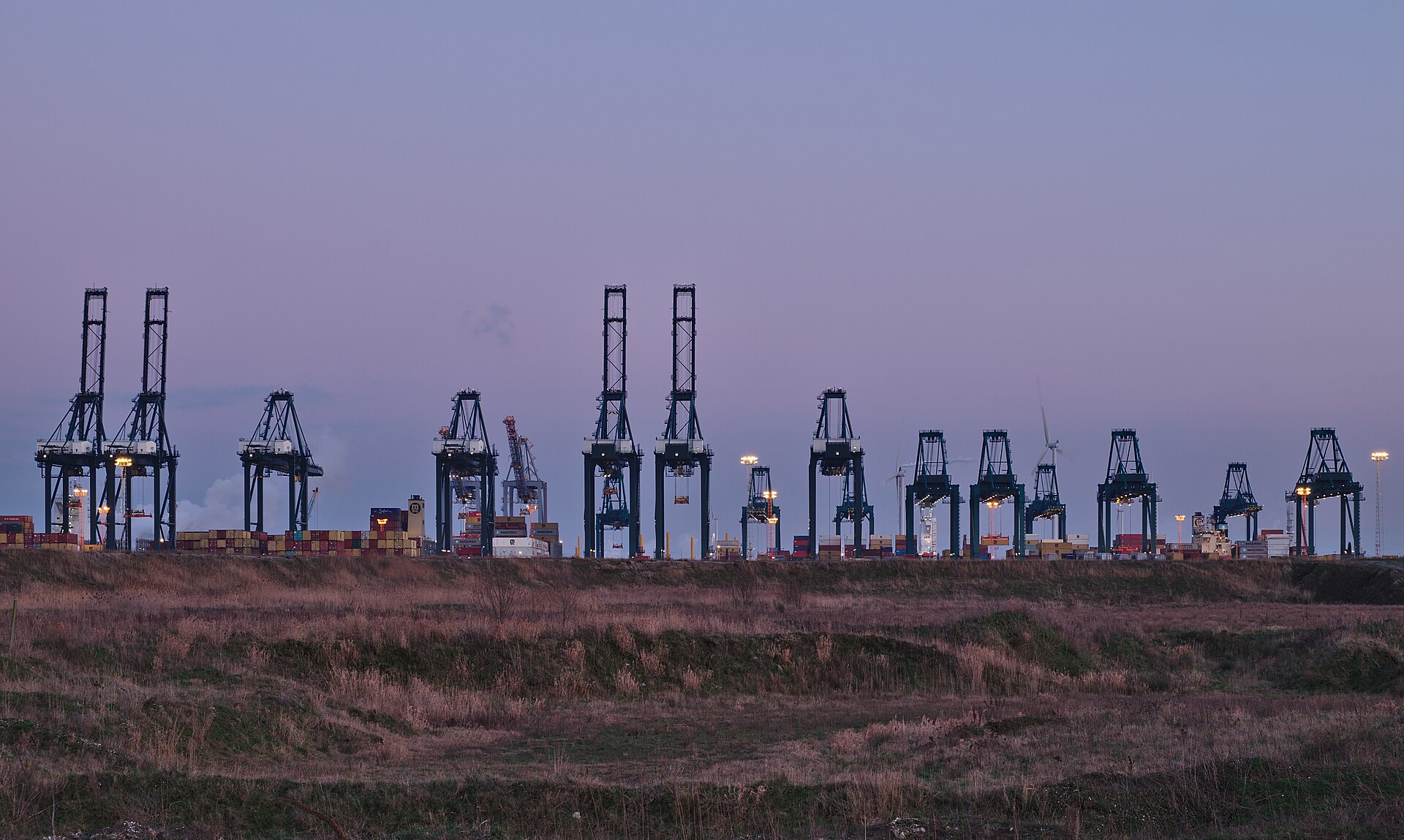
Belgium is not really a market, it is a doorway. Antwerp-Bruges is where a very large share of European imports physically arrive before moving on to buyers in Germany, France, Poland and beyond. That makes Belgian port data one of the best early indicators of EU demand available, and it also makes Belgian importer records genuinely misleading if you read them as domestic consumption.
The 30-second version
- Antwerp-Bruges handled 133.9 million tonnes in the first half of 2026, down 2.4%.
- Container volume reached 6.8 million TEU, down 1.5% in TEU and 3.6% by tonnage.
- Strikes in March and June plus an oil spill in April cost roughly 260,000 TEU on their own.
- Imports from the Persian Gulf fell 57%, and Qatari LNG fell 66% after the final cargo arrived in March.
- Empty container throughput rose 13.7%, which is the clearest measure of how unbalanced the trade has become.
Separating disruption from demand
A headline decline of 2.4% invites a gloomy conclusion about European demand. The detail says something more specific.
Two of the largest declines, Persian Gulf imports and Qatari LNG, are energy contract changes rather than consumer demand. The US figures reflect trade tension and tariff uncertainty. And roughly 260,000 TEU of the container shortfall is directly attributable to industrial action and a single oil spill at Deurganck Dock. Strip those out and the underlying picture for general cargo is soft rather than collapsing.
For anyone selling into Europe, that distinction is worth money. A soft market with disrupted logistics is one where buyers are looking at alternative routings and alternative suppliers. A collapsing market is one where nobody is buying anything. These call for opposite strategies.
The empty container signal
Empty throughput rising 13.7% while full export containers fall 5.7% is the single most informative pair of numbers in the release. It means boxes are arriving loaded and leaving empty, which is to say Europe is importing considerably more than it is exporting through this gateway.
The practical consequence for exporters into Europe is favourable: equipment availability is good and inbound freight rates are competitive, because carriers would rather move a loaded box than reposition an empty one. The consequence for European exporters is the reverse, with tighter capacity and firmer rates on the outbound leg.
Empty containers are an honest statistic. They do not care what anybody forecast.
Why Belgian importer records need care
A very large share of what clears through Antwerp is not consumed in Belgium. It is warehoused, split, and forwarded. Belgium's logistics sector exists precisely to do this, and it means the company named on an import record is frequently a forwarder, a customs agent or a European distribution centre rather than the end user.
Three ways to read through that:
- Check the volume against the company. A firm importing far more of a product than any plausible Belgian use case is a distributor, not a consumer.
- Look for the same importer across many unrelated products. That is a logistics operator's signature.
- Follow onward flows. The real buyer is usually one step further into Germany, France or Central Europe, and the Belgian entity is your route to them rather than your customer.
None of this makes Belgian data less useful. It makes it a map of European distribution rather than a list of Belgian customers, which is arguably more valuable if you know what you are looking at. The Netherlands guide covers the same dynamic at Rotterdam, and the two gateways are genuinely complementary.
What Belgium itself buys
Domestic Belgian demand is real and distinct: chemicals and pharmaceuticals, which are a major national industry, diamonds and precious stones through Antwerp's historic trade, vehicles and components, and food products for a dense, high-income population. The chemical cluster around Antwerp is one of the largest in the world and imports feedstock at scale, which makes it a serious customer in its own right for polymer, solvent and intermediate suppliers. The chemicals buyer guide covers how to approach that base.
Where the 2026 opportunity sits
The routing disruption is the near-term opening. Buyers and forwarders who lost throughput to strikes and the dock closure have been actively testing alternative gateways and alternative suppliers, and some of those tests become permanent. Second, the favourable inbound freight balance makes landed cost into Europe more competitive than it has been, which is a real argument to put in front of a buyer who last priced you eighteen months ago. Third, the energy shift away from Gulf LNG is reshaping the industrial cost base in Belgium, which changes what its chemical sector can make competitively and therefore what it needs to import.
Customs warehousing and why so much clears here
Belgium's share of European import clearance is not an accident of geography alone. It reflects a customs regime that importers actively choose, and understanding it explains a lot of what looks odd in the trade data.
Goods can enter a customs warehouse without duty or VAT becoming payable, and stay there while the importer decides their destination. If they are re-exported outside the EU, no duty is ever due. If they enter free circulation, duty is paid at that point rather than on arrival. For a distributor serving multiple European markets from one stock point, that deferral is worth real money in working capital.
Belgium also operates a VAT deferment mechanism that allows import VAT to be accounted for on the return rather than paid at the border, which removes a cash flow cost that other member states impose. Together these are why a company with no Belgian customers at all may still clear everything through Antwerp, and why importer records here describe logistics decisions as much as demand.
How ShipScout helps
Port statistics tell you the tonnage. They do not tell you whose tonnage. ShipScout does, with 11B+ shipment records across 240+ countries:
- Find importers by HS code across Belgium and the wider EU, ranked by volume.
- Tell distributors from end users by looking at product breadth and volume against plausible use.
- Trace onward European flows so you find the buyer behind the forwarder.
- Pull decision-maker contacts where available and lead with the buyer's own record.
Start a free trial and map the gateway for your product.
See who’s importing into Belgium right now.
ShipScout turns 11B+ shipment records across 240+ countries into a live list of verified buyers and suppliers, ranked by volume, with the contacts to reach them. Create a free account and run your first search in minutes.
Start your free trial →