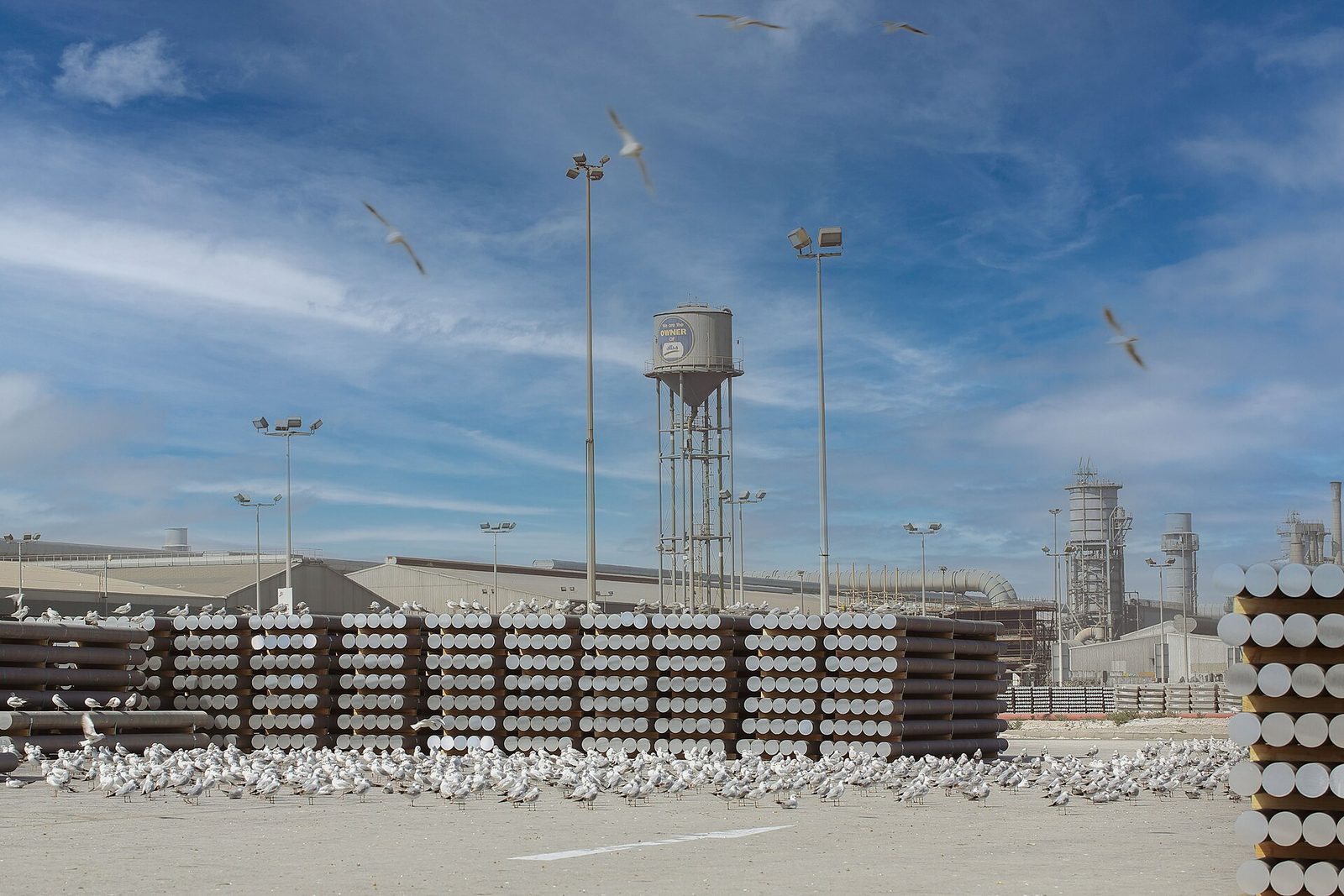
UK CBAM starts on 1 January 2027, and the registration threshold is low enough that most people reading this will be caught by it. Import more than £50,000 of iron and steel, aluminium, cement, fertiliser or hydrogen products in a rolling twelve months and you must register with HMRC, calculate the emissions embodied in those goods, and pay a carbon charge on them. The first return and payment fall due by 31 May 2028. Registration is expected to open through Government Gateway in the final quarter of 2026, which is now. This guide covers what UK CBAM covers, who is liable, how the rate is set, and what separates it from the EU scheme.
The 30-second version
- Live from 1 January 2027. Five sectors: iron and steel, aluminium, cement, fertilisers, hydrogen. Electricity, glass and ceramics are excluded for now.
- Registration threshold: £50,000 of CBAM goods over a rolling 12 months. Both a backward and a forward-looking test apply.
- The liable person is normally whoever the customs declaration is made in the name of, not the overseas producer.
- First accounting period is long: it ends 31 December 2027, with payment by 31 May 2028. Quarterly accounting starts 2028.
- The rate is sector-specific, set quarterly from the UK ETS auction price. The UK ETS reference price for 2026 is £49.41/tCO₂.
What does UK CBAM cover?
Five sectors, defined by commodity code rather than by description. Iron and steel, aluminium, cement, fertilisers and hydrogen are in. Electricity is out, which is the clearest divergence from the EU scheme. Certain imported scrap products within the aluminium and iron and steel sectors are excluded by commodity code, per the GOV.UK registration collection.
The scope reaches further downstream than the sector names suggest. Screws, bolts and fasteners, aluminium doors and structures, nitric acid and ammonia all appear on the goods list, per Valpak's read of the secondary legislation. A construction supplier importing aluminium window frames is a CBAM business whether or not it thinks of itself as one. Sector membership alone does not put a good in scope, and neither does sector absence keep it out. Check the code.
Who has to register, and when?
Anyone whose CBAM goods meet or exceed £50,000 in value. The threshold is tested two ways, and meeting either one triggers the obligation: a backward-looking test checked on the first day of each month covering the preceding twelve months, and a forward-looking test for the coming period, per this breakdown of the HMRC registration process.
The liable person is generally the person in whose name the customs declaration is made. That is a sharper point than it looks. If you buy DDP and your supplier's agent declares the goods, you may not be the liable person. If you buy DAP or FOB and declare in your own name, you are. The Incoterm you agreed last year decides who carries a tax that starts next year, which is a good reason to reread Incoterms 2020 before renewing contracts.
How is the UK CBAM rate calculated?
Liability is embodied emissions multiplied by the applicable UK CBAM rate, minus any qualifying overseas carbon price already paid. The rate is sector-specific and set quarterly from the average UK ETS auction price for the preceding quarter, adjusted for the proportion of emissions covered by free allowances in that sector, per KPMG's summary of the confirmed HMRC framework.
The free-allowance adjustment matters. Sectors where UK producers still receive generous free allocation get a discounted CBAM rate, because the point of the mechanism is to level the field, not to overshoot it. As free allocation phases down, the effective rate climbs even if the carbon price does not move.
The chart uses the UK ETS 2026 reference price of £49.41 per tonne, published as the civil penalty carbon price and derived from the trailing twelve-month average, applied to published emission intensities for the two dominant steelmaking routes. Treat it as an order-of-magnitude guide rather than a quote: your actual rate will carry the sector free-allowance adjustment.
Two mills quote you the same price per tonne. One is blast furnace, one is electric arc. From January 2027 the difference in your CBAM bill is larger than most people's gross margin on the order.
How does UK CBAM differ from EU CBAM?
They rhyme, but they are not the same system, and businesses importing into both will run two sets of numbers.
| UK CBAM | EU CBAM | |
|---|---|---|
| Live from | 1 January 2027 | 1 January 2026 |
| Electricity in scope | — | ✓ |
| Threshold | £50,000 value | 50 tonnes mass |
| Instrument | Direct tax charge | Purchased certificates |
| Price basis | UK ETS, quarterly, free-allowance adjusted | EU ETS auction average |
| First payment | 31 May 2028 | 30 September 2027 |
One is a tax you calculate and pay. The other requires you to buy and surrender certificates. That difference changes cashflow, accounting treatment and who in your business owns the process. The EU side is set out in the CBAM certificate price guide.
What should UK importers do in 2026?
- Screen your commodity codes against the goods list. Do this before anything else, because it determines whether the rest applies.
- Total your CBAM imports over the last twelve months against £50,000. Most importers who assume they are under are not.
- Ask suppliers for installation-level emissions data now. Mills that cannot produce it force you onto default values, and defaults are unfavourable by design.
- Establish who is the liable person on each lane, and change the Incoterm if the answer is wrong.
- Map alternative suppliers by production route and by carbon price already paid in their jurisdiction, since both reduce your bill.
A midlands fabricator ran step two in June and found they were at roughly £310,000 of aluminium extrusions a year, six times the threshold, having assumed CBAM was a steel-industry problem. The registration was the easy part. Getting emissions data out of two of their four suppliers took until October.
How ShipScout helps
Supplier selection is the lever that actually moves a CBAM bill, and that is a shipment-data problem. ShipScout puts 11B+ shipment records across 240+ countries behind one search:
- Search your commodity code with the UK as destination and see every origin currently shipping it, ranked by volume and consistency.
- Compare origins where production routes and carbon pricing differ, then cross-read the steel and iron flows feeding the UK.
- Check a supplier's UK track record before asking them for emissions data, because firms shipping into Britain regularly tend to have the documentation habits already.
- Pull contacts where available and start the conversation with their own shipment history. Wider UK flows sit in UK import data by company.
Registration opens this quarter and the first liability period starts in January. Start a free trial and map the supply base for your codes before the clock starts.
See who’s importing CBAM-covered goods into the UK right now.
ShipScout turns 11B+ shipment records across 240+ countries into a live list of verified buyers and suppliers, ranked by volume, with the contacts to reach them. Create a free account and run your first search in minutes.
Start your free trial →