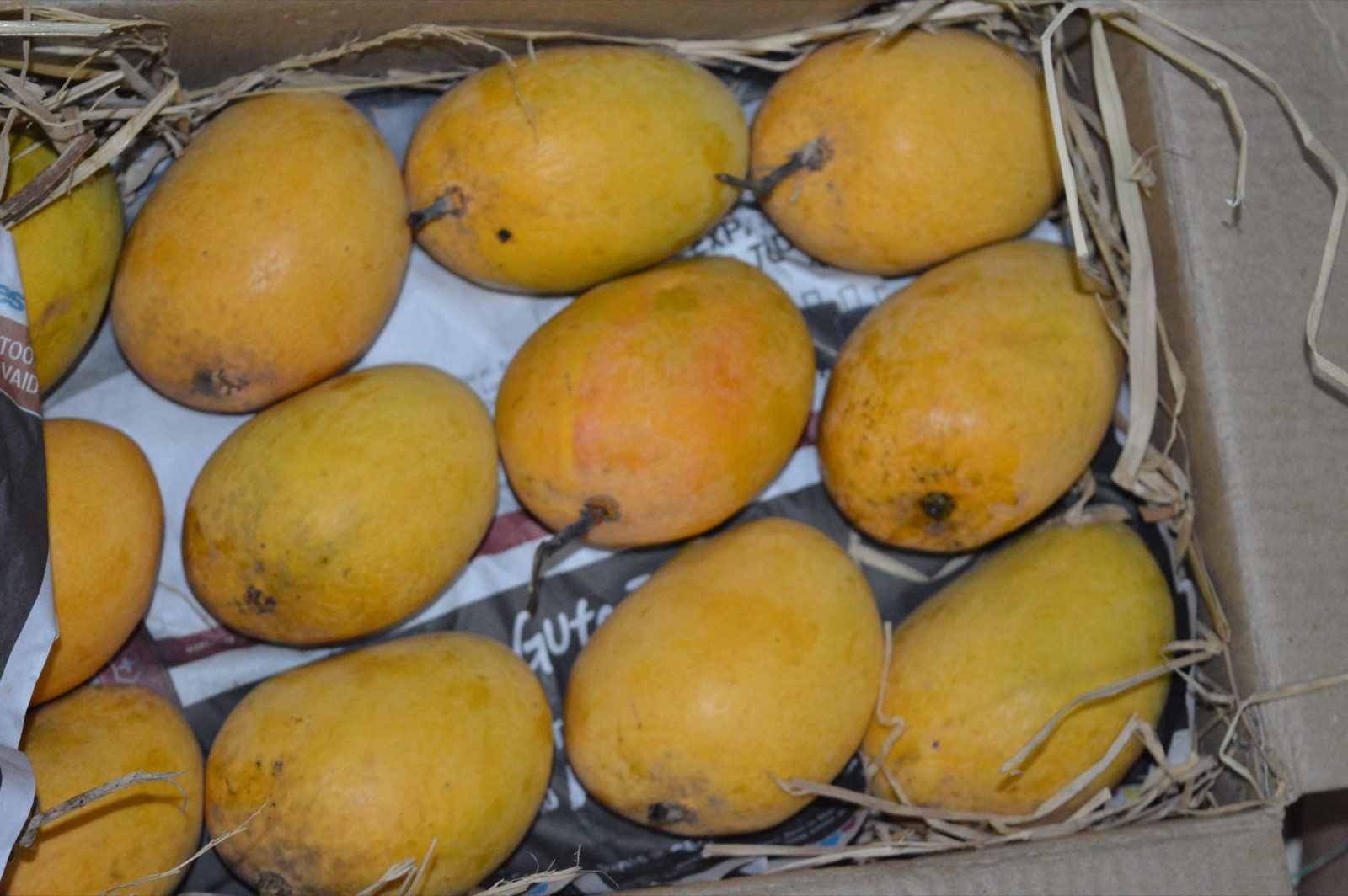
India shipped ₹144.41 crore of fresh mangoes to the UAE alone in 2025-26, with volumes to that single market up 11,622 tonnes year on year (Deccan Chronicle). That is where mango export from India sits today, and it hides a paradox: the country grows nearly half the world's mangoes — roughly 26 million tonnes a year — yet ships out under 1% of the crop (World Population Review). Total fresh-mango exports came to just $56.5 million across 52 countries in FY2024-25 (APEDA).
Exporters who win the eight-week window don't sell to "the Gulf" or "America" in the abstract. They sell to named importers in Deira, Southall and New Jersey whose purchases show up in shipment records, box by box. Here are the verified 2026 numbers, fresh and pulp, and how to turn them into a buyer list.
The 30-second version
- Fresh mango export from India was 29,938 tonnes worth $56.5 million across 52 countries in FY2024-25; FY2023-24 had peaked at $60.14 million (32,104 MT) before climate cut the crop (APEDA, Berrydale).
- UAE is the #1 buyer at ₹144.41 crore in 2025-26, ahead of the UK (₹89.31 crore) and USA (₹82 crore); Nepal nearly doubled to ₹18.71 crore (Deccan Chronicle).
- Mango pulp is the bigger trade: 63,253 tonnes worth $80.34 million in FY2024-25, with India holding about 83% of world pulp exports (APEDA).
- Market access is the real gate — the USA needs 400-Gray irradiation, Japan suspended Indian mangoes for the 2026 season, and Australia and Korea require vapour-heat treatment.
- HS codes: fresh mango ships under 080450, mango pulp under 200799.
What does mango export from India look like in 2026?
A high-value, low-volume premium trade — the opposite of rice or onion. FY2024-25 shipped 29,938.40 tonnes of fresh mango worth $56.5 million, an average of roughly $1.89 a kilo at the border (APEDA). The year before was the recent high: FY2023-24 hit $60.14 million on 32,104 tonnes, a 40% volume jump, before unseasonal weather in Karnataka and Tamil Nadu trimmed the following season (Berrydale). Against a 26-million-tonne harvest, that figure is a rounding error, and the opportunity most growers never touch.
Fresh mango moves under HS 080450 (India's eight-digit line, 08045020), the code that also covers guavas and mangosteens. Search the wrong code and your buyer list returns the wrong fruit. New to the system? Start with what an HS code is and how to use it. One habit separates serious mango exporters from hobbyists: they book the irradiation or heat-treatment slot before confirming the order, because in a trade with a 10-to-12-day shelf life, treatment capacity, not demand, is the binding constraint.
Which country imports the most mangoes from India?
The UAE. It bought ₹144.41 crore of Indian mangoes in 2025-26, well ahead of the UK at ₹89.31 crore and the USA at ₹82 crore, with volumes to the Emirates rising 11,622 tonnes in a single year (Deccan Chronicle). The reported 2025-26 destinations by value:
- UAE — ₹144.41 crore (top by both value and volume)
- UK — ₹89.31 crore (up from ₹76.09 crore in 2024-25)
- USA — ₹82 crore (down from ₹95 crore)
- Nepal — ₹18.71 crore (nearly doubled; an extra 5,772 tonnes)
Kuwait and Qatar round out the historical top five that APEDA lists alongside the UAE, USA and UK (APEDA). The fresh numbers read as a Gulf-and-diaspora trade: the UAE re-distributes regionally, the UK feeds a large South Asian retail base, and the UK-up, USA-down swing is exactly what a mango exporter wants to see months before the season, not after.
Four markets take the bulk of India's fresh mangoes. The importers inside each one — with tonnages, varieties and arrival dates — are named in shipment records long before any agent offers an introduction.
Alphonso and Kesar: the premium that pays the airfare
Alphonso mango export is the segment that makes the economics work. Ratnagiri and Devgad Alphonso — both GI-tagged — plus Talala Gir Kesar from Gujarat and Banganapalli from Andhra Pradesh command the prices that justify air freight. Alphonso quotes run ₹120-300 a kilo FOB (about $1.44-3.60), retail-grade premium fruit lands at $3-6, and freeze-dried Alphonso reaches $5.50-9.50 a kilo (Berrydale). Andhra Pradesh alone now accounts for 8-10% of India's mango exports, with Banganapalli, Benishan and small Rasalu in strong overseas demand (KPIAS).
The shelf-life clock is why Alphonso flies rather than sails. That is starting to change: an ICAR-APEDA sea-shipment protocol carried Banganapalli from Andhra Pradesh to Singapore with shelf life stretched to 30 days, cutting logistics from ₹150-250 a kilo by air to ₹13-20 a kilo by refrigerated container (Rural Voice). If that protocol scales, the addressable buyer list widens from air-served Gulf cities to any port within a month's sailing.
The market-access wall: USA irradiation and Japan's 2026 shutout
For premium Western markets, the barrier isn't demand but the phytosanitary protocol. The United States requires every Indian mango to be irradiated at a minimum absorbed dose of 400 Gray from a Cobalt-60 source under USDA APHIS rules (7 CFR 305), at roughly $3 a kilo, through one of three approved facilities before a USDA officer signs the PPQ 203 certificate (Berrydale). The paperwork is unforgiving: in May 2025, about 25 tonnes of Indian mangoes worth an estimated $500,000 were destroyed at Los Angeles, San Francisco and Atlanta over PPQ 203 dosimeter-documentation errors (Karmactive). India resumed US shipments within days once the forms were corrected (FreshFruitPortal).
Japan is the cautionary tale. After nearly two decades of access under vapour-heat treatment, Japan suspended Indian fresh-mango imports for the 2026 season, citing deficiencies in fumigation and disinfection at Indian treatment facilities — closing a lane that had run on just six approved varieties (Alphonso, Kesar, Banganapalli, Langra, Chausa and Malika) (Business Standard, IndiFoodBev). Australia and South Korea also gate entry behind vapour-heat treatment; India shipped only 58.42 tonnes to Australia and 43.08 tonnes to Japan in a recent season. US import data is fully public, so a mango exporter can read exactly which American distributors clear irradiated fruit each May — see US import data by company.
Mango pulp vs fresh: the bigger, quieter trade
Fresh mango gets the headlines; mango pulp earns more money. India exported 63,253 tonnes of pulp worth $80.34 million in FY2024-25 — bigger than the entire fresh trade — and holds roughly 83% of global pulp exports (APEDA). Pulp ships under HS 200799 (India's line 20079910; some cooked preparations move under 20089999), and it plays by different rules: no shelf-life panic, no irradiation slot, sea freight in aseptic drums. Top buyers are Saudi Arabia, the USA, the UK, Germany and Canada; Totapuri and Alphonso pulp from the Chittoor-Krishnagiri belt fill the drums. If air-freight logistics or treatment capacity is your wall, the pulp lane is the workaround — the full picture is in mango pulp export data, and the broader basket in food and agro export data.
India grows half the planet's mangoes and exports under one percent of them. The gap between what's grown and what's shipped is the whole business case — and every buyer that could close it is already importing from someone.
Mango export from India: the ShipScout buyer workflow
ShipScout is a global trade-intelligence platform — 11 billion-plus shipment records across 240+ countries, built as an affordable alternative to Panjiva and ImportGenius. It helps Indian mango exporters find and vet overseas buyers with data-backed targeting, working from mirrored licensed trade data for India-linked trade. The mango play:
- Search HS 080450 and 200799. See which importers in Dubai, London, New Jersey and Riyadh are receiving fresh mango and pulp right now, and how often. Start in the company directory.
- Rank buyers inside one lane. A UAE importer clearing containers every week outranks ten one-off buyers — sort by volume and work the top of the list; the Gulf re-export logic sits in UAE trade data.
- Vet before you ship on credit. Perishables can't absorb a default or a rejected container — here's how to verify an international partner before paying.
- Reach the decision-maker. Contact intelligence, where available, beats the generic info@ inbox; the wider method is in finding buyers for export from India.
Mango export from India is a small slice of a giant harvest, and the buyers who take that slice already sit in the mango export data. Start a free trial and search HS 080450 to read the list.
See who’s importing mango buyers right now.
ShipScout turns 11B+ shipment records across 240+ countries into a live list of verified buyers and suppliers — ranked by volume, with the contacts to reach them. Create a free account and run your first search in minutes.
Start your free trial →