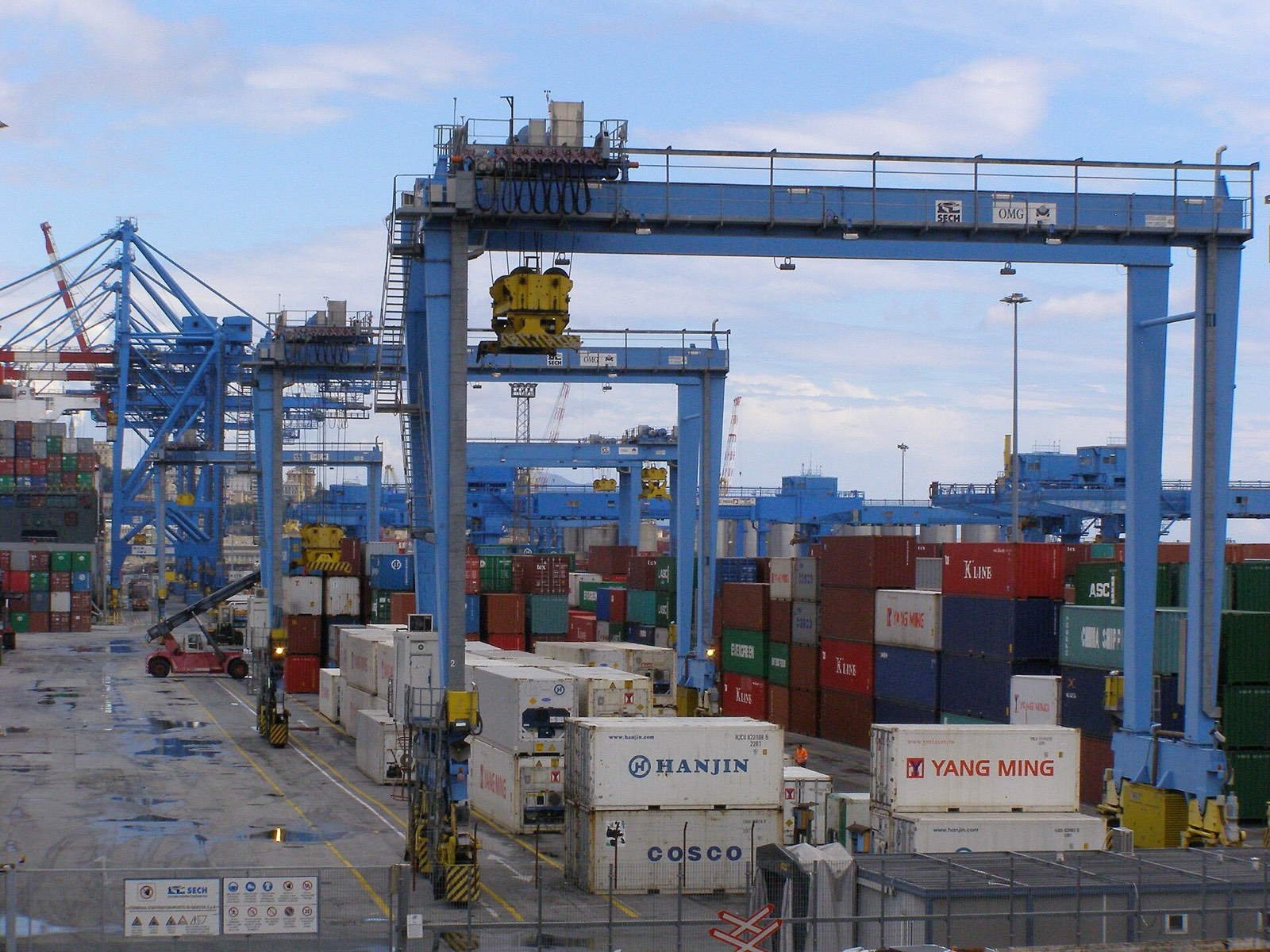
Gioia Tauro moved a record 4,490,566 containers in 2025, up 14% and the first time Italy's largest port cleared four million TEU in a single year, per TrasportoEuropa. Most of that is transhipment, boxes swapped ship-to-ship, but the throughput hints at the market behind it: Italy imported US$639.9 billion of goods in 2023, its last fully broken-down year, per World Bank WITS data. Italy import data for 2026 tells you who inside that flow is actually buying: which HS codes move, which countries supply them, and which Italian importers you can reach. This guide breaks down Italy's top imports, its major ports, how EU customs works, the India–Italy lane, and how to turn shipment records into a ranked list of buyers in Italy.
The 30-second version
- Italy imported US$639.9 billion of goods in 2023; ISTAT reports imports fell 3.9% in 2024, then rebounded +6.9% in Q1 2025.
- Germany supplies $97.0B (about 15%), China $51.5B, France $50.3B, the Netherlands $39.4B and Spain $35.4B.
- Energy leads the bill; combine HS 84 and HS 85 and machinery is Italy's single biggest import need, above $100B.
- Three ports carry the trade: Gioia Tauro (4.49M TEU), Genoa (3.0M TEU) and Trieste, the rail gateway to Central Europe.
- Italy is India's 3rd-largest export market in the EU; two-way trade hit US$13.74B in FY2025.
What does Italy import the most?
Energy first, then machines. Italy has almost no domestic oil or gas, so mineral fuels top the bill at roughly $75.6 billion, ahead of industrial machinery ($54.7B), electrical machinery ($47.7B), motor vehicles and parts ($45.3B), pharmaceuticals ($30.8B) and iron and steel ($28.5B), per category data. Add the two machinery chapters together, HS 84 and HS 85, and capital equipment for Italy's manufacturing base is what the country buys more of than anything else.
| Category | Import value | Key HS chapters |
|---|---|---|
| Mineral fuels and oils | $75.6B | 27 |
| Industrial machinery | $54.7B | 84 |
| Electrical machinery | $47.7B | 85 |
| Motor vehicles and parts | $45.3B | 87 |
| Pharmaceuticals | $30.8B | 30 |
| Iron and steel | $28.5B | 72 |
On the supply side, Germany dominates at $97.0 billion, close to 15% of everything Italy buys, ahead of China ($51.5B), France ($50.3B), the Netherlands ($39.4B) and Spain ($35.4B), per World Bank data. Roughly half of Italy's imports come from inside the EU single market; the rest lands at the ports below. New to chapter codes? Start with how HS codes work.
Where does Italy import data come from?
Italy import data comes from two official layers, and both are anonymous. ISTAT, the national statistics office, publishes monthly goods trade by product and partner country, and Eurostat republishes the same flows EU-wide through its Comext database. Both are free and reliable. Neither names a single importer.
That is the EU catch. Unlike the United States, the EU does not release bill-of-lading manifests or consignee names, so no official Italian source will tell you who imported HS 8479 machinery into Genoa last quarter. The aggregate Italy trade data tells you the what and the how much, never the who. Practitioners close the gap with mirror data: partner-country export records that show who shipped what into Italy, matched with licensed shipment databases carrying Italian consignee names where disclosure rules allow. The method is the same one behind finding buyers with customs data anywhere, and a quick read on how to read a bill of lading covers the fields you will rank on. It mirrors the Netherlands import data picture next door.
Italy's major ports: Genoa, Gioia Tauro and Trieste
Three ports carry most of Italy's containerised trade, and each does a different job.
Gioia Tauro is the giant. The Calabrian hub handled 4,490,566 TEU in 2025, up 14% and a record, with around 40% of every container moving through Italy's port system passing across its quays, per TrasportoEuropa. It is a transhipment hub first, where cargo mostly changes ships rather than entering Italy, but it plugs the country into Mediterranean trunk routes reaching 120 ports worldwide.
Genoa is the gateway. The Ports of Genoa system cleared 2,999,486 TEU in 2025, an all-time high and up 6.3%, of which 1.92 million TEU were full import/export boxes feeding the industrial north around Milan and Turin, per the port authority. If you want the containers that actually clear Italian customs and reach Italian factories, Genoa is where they land.
Trieste is the back door to Central Europe. The Adriatic port handled more than 54 million tonnes of cargo in 2024 and runs Italy's densest port-rail network, over 11,000 freight trains a year into Austria, Germany, Czechia and Slovenia, with an oil terminal feeding the Trieste–Ingolstadt pipeline, per reporting on the port's 2024 results. Much of what lands at Trieste is bound for landlocked Europe, not Italy.
Read the port before you read the buyer. A container into Gioia Tauro is probably leaving again; a container into Genoa is probably staying. That one distinction changes which consignees are worth an email.
The India–Italy trade lane: leather, textiles and machinery
How big is India–Italy trade? Two-way merchandise trade reached US$13.74 billion in FY2025, and in the first eight months of FY2026, through November 2025, it hit $9.32 billion, with Indian exports of $4.89B against $4.43B of imports, per IBEF. Italy is India's third-largest export market in the EU.
The mix is shifting. Iron and steel now lead Indian exports to Italy at $823 million, ahead of electrical machinery ($526M), mechanical machinery ($493M), organic chemicals ($291M) and vehicles ($267M), per IBEF. The older pull is still there, though: Italy's Tuscan tanneries and fashion houses make it one of the world's biggest buyers of finished leather (HS 41) and leather goods (HS 42), and its textile mills take Indian cotton and garments (HS 52, 61, 62). Going the other way, Italy sells India machine tools and industrial machinery, about $2.22 billion of HS 84 equipment in 2024 alone.
For an Indian exporter, Italy is a fragmented, quality-driven market of family-owned manufacturers, not a handful of giant buyers. That rewards data-backed targeting: build a shortlist of Italian importers whose recorded volumes match your capacity before you pitch a single one.
How to use Italy import data to find Italian importers
How do you find buyers in Italy? Since no EU register names consignees, you work from mirror shipment records and rank. The sequence that holds up:
- Fix the HS code first. Italian buyers filter on 6-digit headings plus EU CN subheadings; the wrong chapter poisons every later step.
- Pull mirror shipment records. Partner-country export data shows shipments into Italy with product, value, volume and, where available, the Italian consignee.
- Rank by consistency, not size. A dozen shipments a year marks a working importer; one spike is often a one-off project buy.
- Split gateway from transhipment. A Genoa or Trieste consignee is buying for use or resale in Europe; Gioia Tauro volume is usually passing through.
- Verify before you quote. Cross-check trade history and company records, then open with the buyer's own numbers.
An exporter shortlisting Italian buyers skipped the two household-name traders and emailed the mid-table importers ranked fifth to ninth by shipment count. Three replied inside a fortnight. Mid-size Italian firms still answer their own inbox.
How ShipScout helps
ShipScout puts 11B+ shipment records across 240+ countries behind one search box, including the Italy import data trail visible through partner-country records:
- Search your product or HS code with Italy as destination and see real flows: values, volumes, origins and dates.
- Rank Italian importers by shipment count and consistency instead of trusting directory listings.
- Profile before pitching. Open any company in the importer directory to see trade history, sourcing countries and product mix.
- Reach out with contact intelligence where available, leading with numbers from the buyer's own lane.
A $639.9 billion import market funneled through three of the Mediterranean's busiest ports means someone in Italy is already buying what you make. Start a free trial and pull your first ranked list of Italian buyers today.
See who’s importing goods into Italy right now.
ShipScout turns 11B+ shipment records across 240+ countries into a live list of verified buyers and suppliers — ranked by volume, with the contacts to reach them. Create a free account and run your first search in minutes.
Start your free trial →